- Microprocessor is used in every Electronic Device where we need to run a program, and the type of microprocessor needed in it depends upon the scale of the program needed to run
- 8085 - The first microprocessor was built in early 1970s, later 8086 was build by collaboration of IBM and Intel
- The breakthrough came in year 1991 by pentium1 (80586), which ran 3D video games, that ran huge media empires
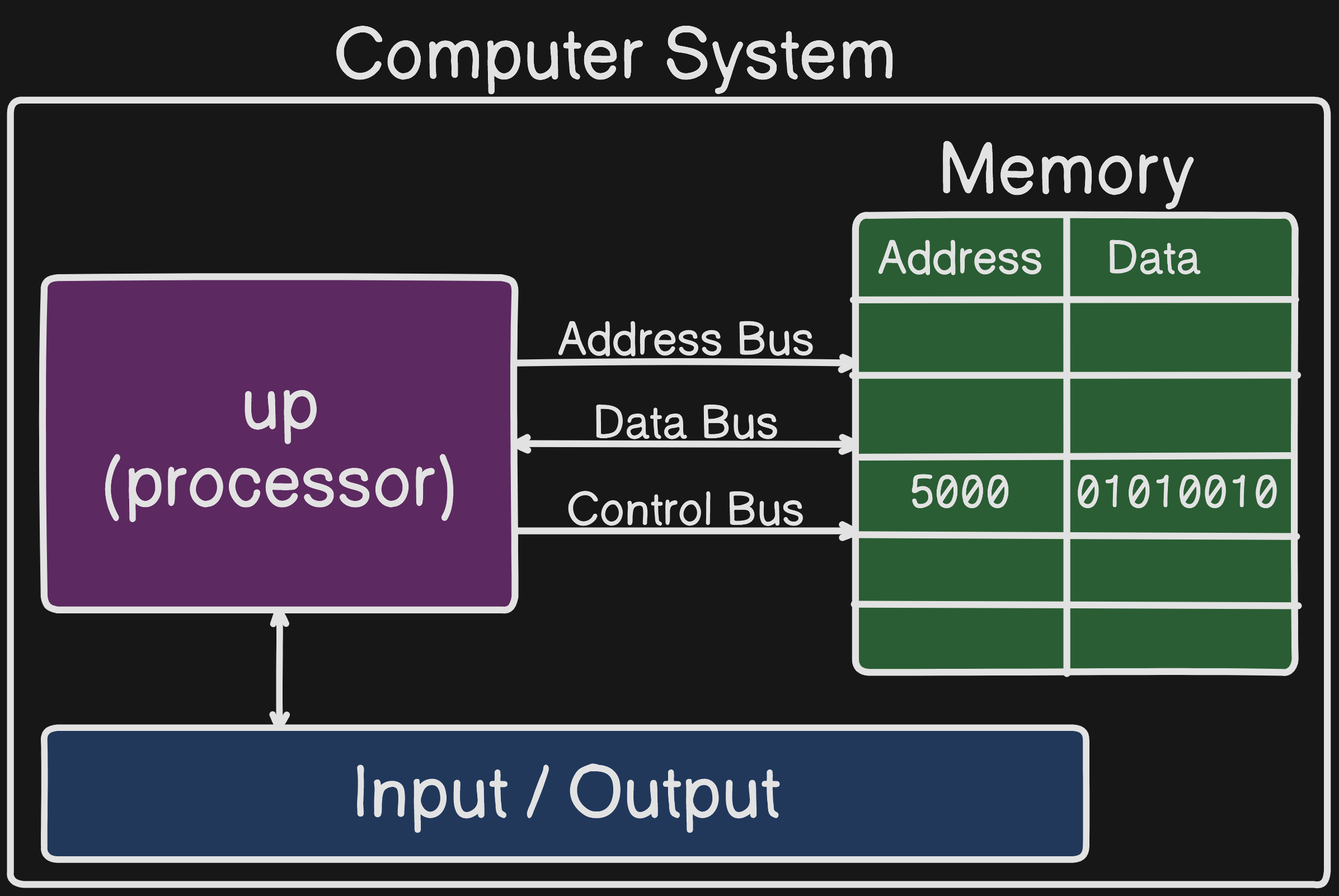
- when we run a program in Computer like opening MS Word then ALU (up) fetches instructions from memory (Instructions fetch happen only through the memory), then it decodes and run the instructions
- The programs are stored in memory they are store in binary form, that binary format it is stored is called as opcode
- Computers work in Hexadecimal format, thus everything we write is in the hexadecimal format
Q But why we use hexadecimal, why not decimal ?
A Decimal consists of 9 digits, while hexadecimal consists of 16 digits, thus we get more permutations and combinations in hexadecimal in same space compared to decimal
-
In hexadecimals format, if we consider 8 bit it’s range is from 00H to FFH and it’s called byte. And when it comes to 16 bit it’s range is from 0000H to FFFFH and it’s called word
-
There will be there buses between processor(microprocessor) and memory, they are like lines which transmit data
-
There are three buses collectively called as system buses
- Address Bus: Allocate the address which is free
- Data bus: Transmit data from processor to memory and vice versa (bi-directional)
- Control bus: It’s used to read and write data
- Writing into memory - Address bus will find an empty address and tell to control bus, data bus will collect data from processor and give it to control bus, Control bus will write into Memory at allocated Address
- Reading from memory - Processor will ask the address, and the address bus will give the address to control bus, the control bus will read the data and pass it to data bus, and data bus will share it to processor
-
These buses give us idea of capability of the processor
-
For example, the larger the
Address busthe bigger is the memory, the buses are just lines which can be connected to VCC and ground. If we havennumber of lines when we can access2 ^ namount of locations thus the larger the Address bus the bigger is the memory. Thus 8085 have 64KB memory as it have 16 Lines in Address Bus -
The relation between address and memory ⇒
n Bits-2 ^ n Bytes. For example, 256GB iPhone will have 38 Bits Address Bus in it -
The speed of the Microprocessor is depended on the number of lines in the Data bus. For Example, In 8085 there is an 8bit Microprocessor means it has 8 lines
-
Now the control bus does not have any lines; it has
control signalswhich do the read and write operations as shown in the table below:
| Operation | IO/M (0 = Memory, 1 = I/O) | RD (0 = Read Active) | WR (0 = Write Active) | Meaning |
|---|---|---|---|---|
| MR (Memory Read) | 0 | 0 | 1 | Read data from memory |
| MW (Memory Write) | 0 | 1 | 0 | Write data to memory |
| IOR (I/O Read) | 1 | 0 | 1 | Read data from input/output port |
| IOW (I/O Write) | 1 | 1 | 0 | Write data to input/output port |
Note: Little Indian Rule: To understand this rule, let us take an example. Let’s say I have a 16-bit number, 1234 (Hexadecimal Number) and I need to store it in memory. Then I need two addresses to store it, as in 8085 an address can only store an 8-bit number. But how do you divide the number to store in two addresses?
Here comes the Little Indian rule; it says that Lower Byte is Always at the Lower Address. Now in 1234, the lower bytes are 34 and the higher byte is 12, because if we change 34, the value will not change that much; they are insignificant.
Now the 12 will be stored in the highest/early accessible address like 0000, and 34 will be stored in the next accessible address like 0001. With this Little Indian Rule, we can also confirm the order of the data by considering the address of the data they are stored in.
Now when we open an application for say WhatsApp, the first address of the WhatsApp program will go into the processor and again will go into memory via buses and read the instructions to run the program, and the messages will populate from the same memory. Both WhatsApp program and its data will be present in the memory.